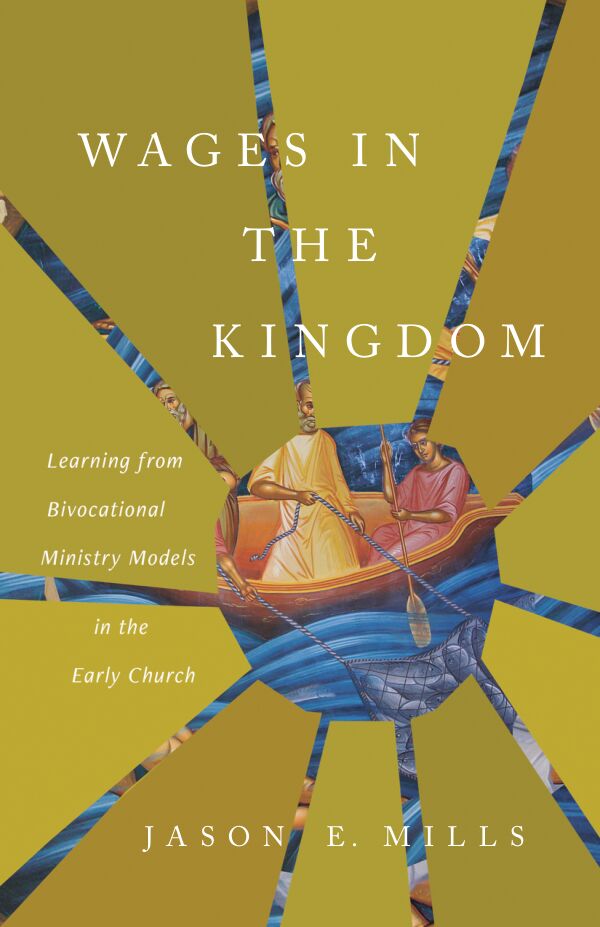
The Foreword I Didn’t Expect: When Dr. Stanley Porter Read Wages in the Kingdom
A couple of months ago I wrote a blog post about the importance of book forewords and the struggle I was having to find an established scholar willing to consider writing one for Wages in the Kingdom.
Hearing my dilemma, my carpool friend suggested I reach out to Dr. Stanley Porter.
In many ways, Stan is an obvious choice. He is the President and Dean of McMaster Divinity College, the school where I did my MA in Christian Studies. Stan had also read one of my early chapters on New Testament backgrounds. He gave very helpful feedback on my early draft, including urging me to use my own voice and rely less on the voices of other researchers.
Stan is a prolific author and scholar. He has written more than 130 books and published over 400 articles and book chapters. The overwhelming majority of these publications have been in the field of New Testament studies.
I was more than a bit skeptical that he would be willing not only to endorse my book but also to write a foreword for it. After all, my book challenges the traditional interpretation held by many scholars that the New Testament advocates for Christian leaders to be financially supported by the churches they serve.
To my delight, Stan agreed to read my full manuscript and write a foreword. And to my astonishment, the foreword was not just a polite way of saying, “The book is worth a read even if I don’t agree with everything.” Instead, he used terms like “significant contribution” to describe my research:
The situation in churches in both Canada and the United States is even more urgent now than it was twenty-five years ago, requiring even more daring and creative thinking than previously. It is in this context that Jason Mills makes his significant contribution. This is a book that at first appears to be about bi-vocational ministry. However, it is much more than that in several ways.
I was surprised. But the next part surprised me even more.
Stan goes on to suggest that the arguments are “challenging”, “provocative”, and even “convincing”(!):
[M]ost of this challenging and provocative and, I dare say, convincing book is devoted to examining at length the New Testament support for a paid ministry and questioning it. As tempting as it might be to engage with the variety of New Testament and later texts that Jason examines, I will merely say that he provides provocative and insightful exegetical analyses of the standard texts used to justify a paid ministry and offers plausible alternative explanations that do not include payment of wages or salaries, even if some other forms of support might be warranted based on personal circumstances in some situations.
But it was the conclusion of the foreword that really caught my attention.
Stan concludes like this:
[T]his book is about much more than bi-vocational ministry. It is about a complete reconceptualization of the church grounded upon an insightful reading of the primary texts of the New Testament and the early church.
I commend this book highly as a provocative means of addressing a major issue in the contemporary church, but also as a clarion call to reconceptualizing the church itself.
Stan captured exactly what I hoped to communicate when I wrote the book. Wages in the Kingdom is about bi-vocational ministry, but ultimately, it is about something much larger: how we understand the church.
I am grateful for Stan’s willingness to read my book, engage with it seriously and sincerely, and write the foreword.